
Industrial operations visibility is not the same as having video. The missing layer is structured evidence about what happened, where it recurred and what changed after action.
Physical AI can close part of that gap by converting selected visible activity into operating records. Workplace safety is a practical starting point because recurring forklift-pedestrian interactions, restricted-area entries and similar conditions can be reviewed over time by place and operating window.
Businesses have spent decades digitizing almost everything.
ERP systems know what was ordered, produced, shipped, and invoiced. Warehouse management systems know where inventory should be. Transportation systems track shipments. Safety systems record incidents, inspections, and corrective actions.
Yet there is still a significant gap.
What actually happens in the physical operation is often poorly represented in the digital one.
Consider a warehouse floor.
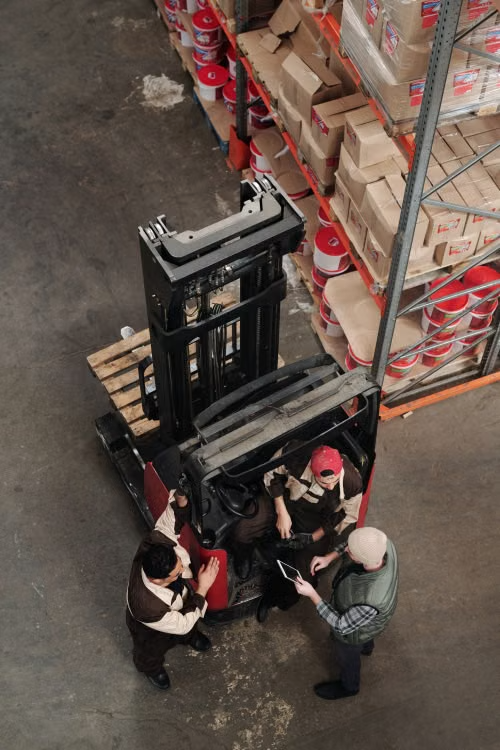
A forklift approaches a busy intersection. A pedestrian crosses through the same area. Pallets temporarily obstruct visibility. Traffic builds around a loading area.
People working there may see these things. Cameras may record them. Occasionally, something becomes an incident or gets documented during an inspection.
But most of this activity simply happens and disappears.
The enterprise systems running the business may never know it occurred.
Why recorded industrial activity is not yet queryable
Industrial sites already have cameras, sensors, access systems, telematics, and other sources of information.
The problem is not necessarily a lack of data. It is turning that data into useful operational evidence.
Consider a facility with 50 continuously recording cameras. That's 1,200 hours of footage every day, or 36,000 hours over 30 days.
The problem isn't capturing more information. It's finding the few events and recurring patterns that matter.
A safety leader doesn't need another thousand hours of video. They need answers:
- What happened?
- Where did it happen?
- How often is it happening?
- Is the same exposure recurring?
- Are particular locations or times consistently involved?
Without structured answers, organizations are left with familiar problems: missed leading indicators, manual video review, fragmented visibility across sites, limited evidence for corrective actions, and difficulty determining whether conditions improved after an intervention.
That is the gap between recording an operation and understanding it.
Workplace safety makes the industrial visibility gap concrete
Safety is a particularly important place to solve this problem because incidents tell only part of the story.
A pedestrian entering a forklift operating area does not necessarily result in an accident.
Neither does a blocked walkway.
Neither does a recurring vehicle-pedestrian interaction.
But imagine the same warehouse intersection producing repeated pedestrian-forklift interactions shortly after every shift change.
Nothing happens on Monday.
Nothing happens on Tuesday.
There may be no report to investigate and no injury statistic to appear on a dashboard.
But after several weeks, a pattern exists.
That pattern is operationally important even though no individual event became an incident.
The question changes from "Did an accident happen?" to "What conditions keep occurring that could eventually contribute to one?"
That is the difference between measuring incidents and understanding exposure.
From camera footage to operational history
Once relevant physical activity becomes structured data, safety teams can begin asking questions that are difficult to answer from recordings and incident reports alone.
Where are pedestrian-forklift interactions occurring most frequently?
At what times?
Are they becoming more frequent?
Did the measured exposure change after traffic flow was adjusted?
Did the frequency of the exposure change after pallet staging was moved?
What happened to the measured exposure after corrective action was taken?
These before-and-after comparisons don't, by themselves, prove that an intervention caused a change. But they give safety teams objective evidence about what was observed before and after action was taken.
Organizations already invest significant effort in training, signage, process changes, facility layouts, and other controls.
The harder question is often what happened in the operation afterward.
Observe → understand → act → measure
The value isn't simply identifying another event. It is understanding whether the measured conditions are improving over time.
Making physical operations queryable
Computer vision, sensors, edge computing, and increasingly capable AI systems are changing what can be understood about physical environments.
The important development may not be any individual AI model.
It is the ability to convert selected physical activity into structured operational evidence that people can search, compare, investigate, and act upon.
Enterprise software made transactions queryable.
We are beginning to make more of the physical operation queryable too.
At Edgentik, we're approaching this through workplace safety.
We help organizations turn existing camera data into structured safety events and exposure history, so teams can identify recurring patterns, review the evidence, take action, and measure what happens afterward.
The operating unit is place and time: Edgentik organizes observable site conditions and recurring exposure patterns within defined camera coverage so safety teams can investigate and act.
Safety is a natural place to begin.
The cost of missing a pattern can be significant. Exposures recur. Changes can be measured over time. And much of the infrastructure needed to observe the environment already exists.
The objective isn't to replace safety professionals or generate more alerts.
It is to give them better evidence about what is repeatedly happening in the operation.
Because sometimes the most important thing a camera captures isn't the incident everyone investigates.
It's the pattern that happened a hundred times before it.
Two concrete applications are forklift-pedestrian safety monitoring and restricted-area monitoring using existing cameras.
See how the thesis becomes a practical safety measurement.
Read the concrete pieces on recurring patterns, incident timing and a real terminal operating context.
Turning physical activity into records also creates a design responsibility: decide what the system should retain. Read why Physical AI needs a memory boundary.

Ashish Syal
Founder of Edgentik, building measurable safety intelligence from existing industrial cameras and reviewable evidence.
About Edgentik →